
Last updated: July 2026
Kenya safari tipping isn’t mandatory, but it is customary, and it’s one of the most common sources of last-minute stress for first-time travelers — mostly because nobody quite tells you the actual numbers, and ATMs aren’t exactly common once you’re out in the bush. This guide breaks down exactly who to tip, how much, and how to handle it smoothly so it’s one less thing to think about while you’re actually on safari.
Quick-Reference: Kenya Safari Tipping Amounts
| Who | Suggested Amount | Notes |
|---|---|---|
| Safari guide/driver | $10–$20 per person, per day | The single most important tip on your trip |
| Trackers/spotters (if separate from guide) | $5–$10 per person, per day | Common on conservancy or specialist wildlife safaris |
| Camp/lodge general staff | $5–$15 per person, per day | Usually pooled via a communal tip box |
| Porters | $1–$2 per bag | At camps, lodges, and airports |
| Airport/transfer drivers | $5–$10 per transfer | One-off, not per day |
A simple overall budgeting rule many travelers use: plan for roughly $25–$40 per person, per day to cover all tipping across guides, camp staff, and incidentals combined. Set this aside in cash at the start of your trip so it’s one less thing to manage once you’re out on safari.
Why Tipping Matters in Kenya
Kenya doesn’t have a strict, obligatory tipping culture the way some countries do — but in the safari and tourism sector specifically, tipping is a genuine and expected part of how guides and camp staff are compensated. For many guides, tips make up a meaningful portion of total income, on top of a base salary. Camps that see consistent tipping also tend to retain their most talented, experienced guides for longer, which directly improves the experience for every traveler who follows.
Tipping Your Safari Guide
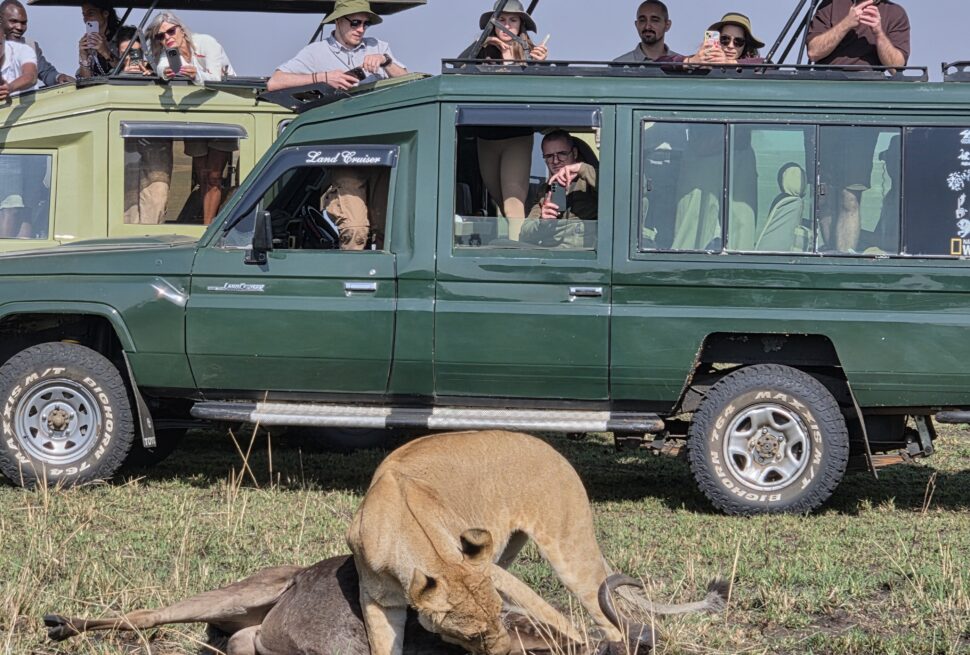
Your guide is the person whose decisions shape almost every part of your day — which tracks to follow, how close to approach wildlife safely, and how to interpret what you’re seeing in real time. It’s widely considered the most important tip on any Kenya safari.
Typical range: $10–$20 per person, per day, depending on group size, safari style, and service quality. For a private guide handling a small group exceptionally well, the higher end (or beyond) is common.
When to give it: At the end of your stay with that guide, directly and privately, rather than mid-trip.
A simple example: for a 5-day safari, a solo traveler might budget around $75 for guide tips ($15 x 5 days); a couple would double that; a family of four might land around $300 in guide tips alone across the trip.
Tipping Camp and Lodge Staff
Behind every clean tent, plated meal, and turned-down bed is a team you’ll rarely interact with directly — housekeeping, kitchen staff, waitstaff, and general camp support.
Typical range: $5–$15 per person, per day, usually deposited into a communal tip box at reception rather than handed to individuals. Camps pool and split this fairly among the team.
A note for families: if traveling with children who received extra attention from camp staff, an additional small tip is a thoughtful (though optional) gesture.
Tipping Trackers and Spotters
On some conservancy safaris or specialist wildlife-tracking experiences, a dedicated tracker or spotter works alongside your guide, often using traditional tracking skills to locate wildlife the vehicle alone wouldn’t find.
Typical range: $5–$10 per person, per day, tipped separately from your guide’s tip.
Porters and Transfer Drivers
- Porters handling your luggage at camps, lodges, or airports: $1–$2 per bag is standard.
- Airport or transfer drivers (a one-off transfer rather than your main safari guide): $5–$10 per transfer is a reasonable guideline.
Practical Tips for Handling Safari Gratuities
- Bring small denomination US dollar bills ($1, $5, $10, $20) — these are the most widely accepted and easiest to distribute across a trip. Kenyan Shillings work too, particularly for smaller tips at camps.
- Withdraw or exchange cash before you leave Nairobi — ATMs are rare once you’re out on safari, and you don’t want to be caught short on your last day at camp.
- Consider a group tipping envelope if traveling as a family or group — pooling tips into a single envelope for your guide avoids any awkwardness around who gives what.
- Ask the camp manager if you’re unsure — every property has its own tipping norms and communal box policies, and staff are used to explaining this to first-time visitors. There’s no need to feel embarrassed asking directly.
- Confirm your operator’s policy in advance — some luxury all-inclusive camps build a suggested gratuity into the package price; most don’t. Ask before you travel so your cash budget is accurate.
Frequently Asked Questions
Is tipping mandatory on a Kenya safari? No, tipping isn’t legally required, but it is a strong cultural expectation within Kenya’s tourism and safari sector, and most guides rely on it as a meaningful part of their income.
How much should I tip my Kenya safari guide? Typically $10–$20 per person, per day, depending on service quality, group size, and whether the safari was private or shared.
Should I tip in US dollars or Kenyan Shillings? Both are accepted, but small-denomination US dollars are generally the most widely preferred and easiest to distribute across a trip.
Do I tip camp staff individually or as a group? Most camps use a communal tip box for general staff, split fairly among the team, rather than individual tipping — check with camp reception if you’re unsure.
How much cash should I budget for tipping on a full Kenya safari? A commonly used guideline is $25–$40 per person, per day, covering guides, camp staff, and incidentals combined across your trip.
This guide reflects general tipping norms for Kenya safaris as of July 2026. Amounts are guidelines, not fixed requirements — always tip based on your own experience and confirm any specific policies with your operator or camp before you travel.